Trust is earned
Build Mode™ Issue 03.2026
Hello and welcome to this issue of Build Mode, a monthly update with brand insights to help you level up your business. We have an ambitious group of professionals working in real estate, architecture, engineering, construction, marketing, design, and development. You all inspire me to keep sharing, so thank you for being here.
Haven’t subscribed yet? Consider joining us and get the next issue delivered straight to your inbox on the first of the month.
Today’s issue is inspired by a recent buying decision, one that I didn’t even place much thought on, even though it was a fairly high-ticket purchase to work with someone I admire.
And after the fact, I realized something…
I didn’t ask to see their qualifications.
I didn’t consider any other options.
I didn’t need to check their references.
I haven’t even met them!
The decision was still a no-brainer.
What I realized was that I trusted them. After years of following them, I knew everything I needed to know to make a decision to invest.
So what can we learn about trust? What intentional actions can we take to set ourselves up for a future where we become trusted by others, and simply chosen?
Let's dig in.

What are trust signals?
Trust isn’t a given (at least not in a business transaction). It’s something you earn, through action, not talk. When someone says, ‘trust me,’ do you abide, or do you look for evidence of trustworthiness? For me, I look for evidence. Especially if I’m making an investment, I look for reasons to trust them with my money.
So, if trust is built on action, how can you build trust with others (and make your brand the one a prospect easily chooses)?
Trust signals.
Trust signals are the subtle cues that convey credibility through evidence.
Accumulated over time, these subtle cues, mostly small, mostly inferred, are how you earn trust over the long term, even before a prospect is ready to buy from you.
Here are the ways you can signal trust through your brand, without ever saying ‘trust me.’
TRUST SIGNAL 1:Your thoughts
Some call this thought leadership. Some call it authority building. When you generously share your ideas and put your thinking into the world, you earn a reputation as someone who just knows their stuff.
Educational content, frameworks, systems, books, newsletters… there are lots of mediums in which you can distribute your ideas. Each of these become trust signals, because they demonstrate your expertise through your thoughts.
However, sharing surface-level knowledge has become easier than ever, so be sure to go deeper, more nuanced, and more unique with your ideas. Name your system. Trademark your approach. Your intellectual property doesn't have to be a registered legal document. It can be a phrase, a framework, a perspective that you own in your market.
The alternative: Keep it all a ‘secret’ because you don’t want anyone to think of you as an authority, only those who work directly with you.
TRUST SIGNAL 2:Your results
The proof is in the pudding, as they say. And your work, well, that’s the pudding. Your thoughts will convey how you think, but it’s the actual work where others will judge your experience and the results you’ve achieved.
What you’ve done:
Case studies, with narratives of the transformation and images of the results, will confirm that what you claim to do, you've actually done. With real world implications, real clients, real constraints, real stakes. Back up your claims of expertise with documented proof that demonstrates it.
Want to be trusted with a $10 million custom home?
Show you’ve done luxury custom homes in your portfolio, or drop a line in a conversation: ‘After wrapping up a $10 million project last year, what we realized was…’
Want to be trusted with mixed-use developments?
Show you’ve done master planning and design on a similar scale, or while talking to a prospect, mention ‘When we planned three projects of a similar scale last year, the pattern we kept seeing was…’
Want to be trusted with a speaking gig in front of 1,000 people?
Show yourself speaking in big rooms, or drop the name of the conferences you've spoken at.
You’re providing context without humble bragging. These signals are useful because the person receiving the message can connect the dots themselves, without you being loud or self-serving. There’s a fine line between promotion and posturing.
Who you’ve worked with:
People don't like risk. They want the safe option, especially when it comes to investing in their vision and their growth, whether in the thousands or millions. Safety is conveyed when prospects can see their own challenges in your solutions.
A university hiring an architect for a new student center wants to see you've designed comparable projects for other reputable universities
An investor considering a fund wants to know there are other credible investors already in the deal
A developer looking for a builder on a $50 million project wants to see a handful of $50 million projects in your portfolio
What they’ve said:
You’ve shown the work, shown who you’ve done it for… so how was it? What did they have to say about the experience? Someone sharing their own experience of engaging with your brand should go beyond ‘great to work with’ … the more specific and detailed, the more credibility and weight it carries.
What others say:
One last note in this section. What others say is about external validation, from publications, industry organizations, awards, and press. These are valuable, with varying degrees of effectiveness, and they are entirely reliant on your marketing strategy. Personally, I think prospects choosing to work with you won’t be heavily swayed by the ‘award-winning’ line in your brand narrative, but, there’s credibility when you earn press and visibility in notable publications.
The alternative to all this: Not showing the work you’ve done, and instead, asking prospects to take a risk and a leap of faith with you off of speculation. Resistance, for sure.
TRUST SIGNAL 3:You
Yes. You! There's a real human on the other side of this message, right? Show me. Especially in professional service industries, where relationship-based work is still a predominant way of doing business, it’s advantageous to show your face. Photos of you. Photos of your team to show scale and capability. Unposed. Unpolished. These are an opportunity to show your personality and indicate, yes, there are real people to work with here. And those that resonate with you, will become even more drawn to you.
The alternative: Not showing your face through photos, and allowing doubt to creep in. Who’s the founder? Who even works at the company? Is there a team? Are they outsourcing to international talent?
TRUST SIGNAL 4:Your space
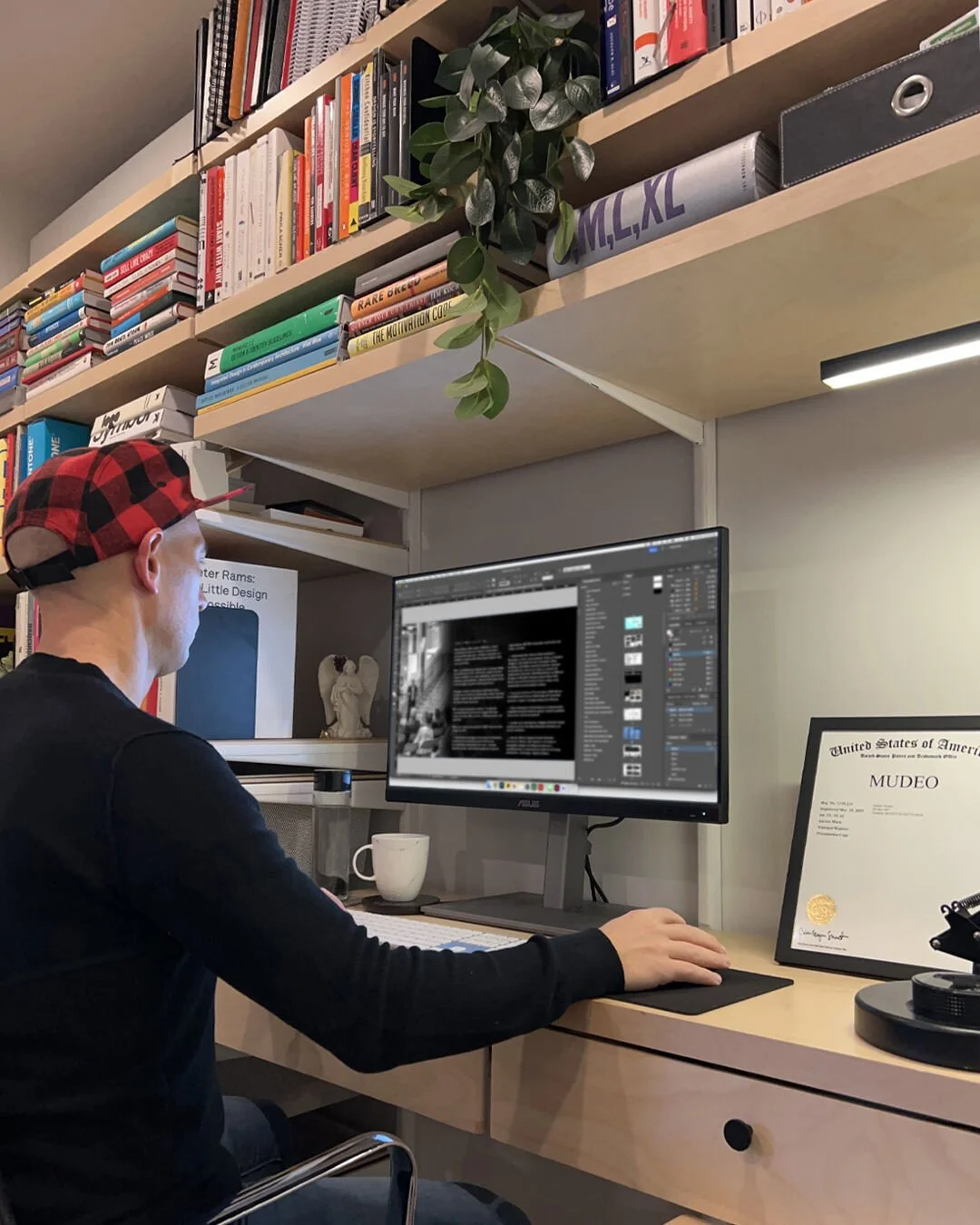
After a couple years of remote work, and a long overdue project of renovating the basement, I finally moved my home office from my bedroom to the basement, and when I did, I was intentional about creating an environment that gave people cues as to who I am, a consultant at the intersection of building, branding, and business. So I’ve dropped the occasional office shot on social media, and in the background of my video calls, my book shelf is always on display. Architects will spot Rem Koolhaas’s S,M,L,XL or Phaidon’s 10x10 with their two-inch book spines, brand designers will spot Symbol from Laurence King publishing or Unit Edition’s Manuals 1, and business types might get a glimpse of Start with Why, Never Split the Difference, or Jab, Jab, Jab, Right Hook.
For me, I love books. It’s been an easy way to share my passion, share more of who I am, and resonate with those who share similar interests. For you, your space might offer different clues.
Your environment is a window into who you are.
If I’m hiring an interior designer, I want to see a massive materials library and beautifully curated material palettes.
If I’m hiring an architect for a large-scale project, I want to see a team of people on a pin-up board or over the table critiquing the work.
If I’m hiring a builder for a luxury custom home, I want to see them on an active construction site on a regular basis.
If I’m hiring a real estate pro, I want to see a track record of successful deals, like a visual tally of deals done, or map room filled with hard data, or a deal wall with personal wins.
The alternative: Not showing your space and missing an opportunity to highlight the way you work, and transparently share your process.
TRUST SIGNAL 5:Your truth
This one is simple: your word is your bond. The more repeatedly you follow through on what you say you’re going to do, the more you’ll be trusted.
You say, ‘I'll get back to you by Thursday with a contract’ — and you ship it by Thursday
You say, ‘If we get your feedback in a timely manner, this project will be six months start to finish’ — and you get it done in six months
You say, ‘I’m going all-in on content creation this year’ — and you write three posts per week for 52 weeks straight
Small promises, kept consistently, compound into a reputation (large ones too, even more so). Do what you say you're going to do. Be who you say you are.
The alternative: overpromising and underdelivering, leading to dissatisfaction, a poor reputation, and unreliability. Woof.
Why do trust signals matter?
Business development is a long game. Networking, coffee, conferences, lunches, introductions, staying in touch — all of it matters. You should be doing it every day. But for someone to buy your brand, hire you, make a bet on you, take a risk on you — it goes beyond knowing you and liking you.
There must be trust (remember, the know, like, and trust framework? And trust doesn't just come from one encounter).
The backing of a strong brand, delivering trust signals, is your qualifier doing your work for you when you’re not in the room. So by the time you are in the room, the decision has already been made.
What you can do nextSending trust signals
Now that you know the five signals of trust and how to send them through your brand, review the list again and see which brand touchpoints you might adapt to start or continue sending out trust signals.
T: Your thoughts
Your ideas, perspective, and thought leadership.
Are you generously sharing your insights so others see you as a credible leader in your industry?
R: Your results
Your work: projects, case studies, and tangible outcomes.
Are you documenting the impact you’ve had and allowing others to contribute to it?
U: You
Yourself and your team — a real, authentic, human presence
Are you sharing more of yourself, to reveal the person or people behind the work?
S: Your space
Your environment where the work happens
Are you letting people into your process, allowing them to see how they can work with you?
T: Your truth
Your word: the promises you follow through on
Are you committing to the things you say you’ll do?
The bottom line
Trust is built in the aggregate. Every touchpoint either adds to it or takes away from it. The goal is to accumulate enough signal, over enough time, that when someone encounters your brand, they feel like they already know you, like you, and, most importantly, trust you.
That’s all for this edition of Build Mode! If this resonated and you’d like to discuss how to send trust signals to build your reputation, get in touch — I’d love to hear from you.
Cheers!
Kenny Isidoro

Well done is better than well said.
— Benjamin Franklin
Work zone
I work with business leaders in build mode, those who are ambitious and in a state of growth. If that's you and you're ready to build, there are two ways I can support you.
Brand audit
An analysis of your brand, plus other industry players, with recommendations for increasing its effectiveness in your business.
Discuss your audit.
Custom-built brand
A core service guiding business leaders through a linear process of defining or redefining your brand in four phases: discover, define, develop, and deliver.
Discuss your project.
Subscribe to Build Mode™
a monthly update with brand insights and how they can apply to your practice and your projects. Issues drop on the first of each month. Feel free to unsubscribe if the updates aren't valuable for you. No hard feelings.