
Build Mode™
Brand principles to elevate your reputation and your business
Join business leaders reading Build Mode™ for actionable insights that strengthen your influence and grow your impact.
To operate in build mode means to be in a state of creation and growth. Ambitious, focused, with the mindset, resources, and conditions to build. To build environments. To build your company. To build and enhance your reputation. Each month, I teach you one brand principle to guide your growth and help you make strategic decisions for your business.
DROPPING ON THE FIRST OF THE MONTHPast issues of Build ModeComfort zone is a brand trap
How to innovate by pushing your brand outside its comfort zone
Build Mode™ Issue 07.2024
I’ve noticed a shift.
On a drive with my family to the South Coast of Massachusetts where I grew up, we often pass through Fall River and right by this enormous, wavy, concrete monument sign that reads ‘Fall River Industrial Park’ in pushed-in letterforms with a high contrast serif typeface painted green. Each time we pass, I think, 'hmm… industrial park? Now that’s an outdated term.'
The latest developers think so too. As the industrial park has grown, they’ve added a new roadway called Innovation Way with new development sites called The Campus at Innovation Way. The naming reflects changes in business from primarily manufacturing and heavy industry to knowledge-based and technology-driven.
Haven’t subscribed yet? Consider joining us below and get the next issue delivered straight to your inbox on the first of the month.
Over the past 20 years, we’ve seen this change all around us. Kendall Square went from an industrial area to now the ‘the most innovative square mile on the planet.’ The Boston Design Center was repositioned as the Innovation and Design Building to attract progressive, technological, creative firms and startups. And every new development looking to attract and cultivate top-tier talent puts innovation front and center. The new Bolling Building in Roxbury houses the Roxbury Innovation Center, providing innovation and entrepreneurship resources in state-of-the-art offices. And the new Assembly Innovation Park in Somerville is pitching to bring the most progressive companies in life science to the area.
These examples are just in Massachusetts but this is surely happening everywhere.
Business has rebranded. The shift from ‘industrial’ to ‘innovation’ reflects a broad cultural shift towards valuing creativity, technology, and forward-thinking businesses.
Out with industry. In with innovation.

What is brand innovation?
It's clear. Innovation is a priority for nearly every modern organization. To evolve with the times, you must adapt (or plan to be a relic of the past). However, to continue to be successful in your business, you not only need to innovate, but to make your innovation visible.
Ask yourself, ‘is my company innovative?’
You’d probably say, ‘yeah, of course!’
What if we asked your customers?... ‘is this company innovative?’
How would they answer?
‘Umm, maybe?’
‘Not sure. We only use them for X.’
‘Possibly, but I don’t know. I haven’t seen it.’
There’s a likelihood that the stakeholders inside a company – leadership, management, employees – are working incredibly hard on new initiatives, new processes, and they all have the sense that innovation is exuding from deep within their soul!
But, if their innovation efforts aren’t communicated effectively… they’re missing out. There’s a mile-wide communication gap between what a company and its staff feel internally, versus what clients and prospects experience and perceive externally.
Brand innovation is the process of developing new and creative ideas that create leverage for your business.
These creative pursuits enhance your brand’s identity and perception in the market. Through strategic differentiation, unique products or services, proprietary systems, or deep resonance with your target audience, you reflect the innovation that exists within your organization to the external world.
If your brand fails to effectively market and communicate its innovation efforts, your clients will continue to remain unaware of your amazing feats and struggle to evolve their perception of your efforts.
It’s time to bridge the gap.
You are now entering the ‘zone’
My oldest daughter plays the bass, and has been for a couple years. She can play just about any genre of music given to her and participates in her school’s orchestra, jazz band, and even set up a rock band with a friend.
She’s quite used to playing music by the book.
Keep your eyes on the chart.
Play what’s written.
Stay in time with the conductor.
Hit every note.

Jazz combos, however, are entirely different.
Last week, she attended a week-long jazz improvisation workshop and was challenged to improvise a solo while playing a classic jazz chart with her combo. There were no charts. Music was learned by ear. And the students were taught approaches to feel the music and improvise within the parameters of the chart.
She stepped outside of her comfort zone and stretched her skills to improvise with creativity and innovation.
There’s a model for the kind of learning that pushes us beyond what we think we’re capable of.
It’s a psychological framework called the Learning Zone model and it contains three distinct areas: Comfort Zone, Stretch Zone, and Panic Zone. While the model is primarily used in educational settings – like a school classroom or a jazz improvisation camp – to encourage individuals to step outside their ‘comfort zone’ and into a growth mindset, I’d like to use this model as a framework for brand innovation. Let’s look into each zone.

Comfort Zone (ie. Status Quo)
In personal development, the comfort zone represents a place where things feel safe and familiar (like reading music that’s been rehearsed), avoiding risks and challenges. It fosters stability but limits personal development.
In brand innovation, the comfort zone is equal to keeping the status quo. It reflects a brand's tendency to stick to the familiar – the same products, strategies, and market segments. The comfort zone is secure and safe for the brand because it’s staying within known parameters and operational efficiencies. The downside is, that while it provides stability and efficiency, it can also lead to complacency and missed opportunities for growth.
Stretch Zone (ie. Innovation)
The stretch zone is where individuals push beyond their comfort zone, taking on new challenges and learning opportunities. It involves moderate levels of discomfort (like taking an improvisational jazz solo) and fosters growth, resilience, and skill development.
In brand innovation, the stretch zone involves exploring new ideas, technologies, and market opportunities that go beyond the brand's current practices. It encourages creativity, experimentation, and adaptation to changing consumer preferences and competitive landscapes. Brands in the stretch zone actively seek to differentiate themselves with a willingness to take calculated risks.
Panic Zone (ie. Risk)
Danger! Danger! We’ve entered the panic zone! The panic zone occurs when individuals face challenges or situations that are overwhelming. It leads to high levels of stress and anxiety. When you reach this level of challenge, you’ve hindered any potential learning and will need to step back to regain your footing.
In brand innovation, the panic zone is where things go wrong. It’s when brands venture too far beyond their capabilities – they take on too much, or go too fast, and lose sight of their objectives toward innovation. When brands get overzealous and enter into the panic zone, new ideas can fail, clients might feel alienated, or operations may go haywire, causing a need to reassess, pivot, or scale back their plans. In the process, brands may damage their brand equity.
Enter the panic zone and you’re entering business risk, susceptible to poorly aligned strategies, ineffective marketing, alienating your customers, or negatively impacting the perception of your brand.
Stay in your comfort zone, and you risk stagnation that limits your opportunities. Without an eye on continuous improvement and innovation, you may lose relevance with your clients and prospects.
Aim to operate in the stretch zone of innovation, exploring new ideas, processes, products, and market opportunities that align with your core values and strategic objectives.
What you can do next to innovate
The problem with most brands is that they don’t recognize the stretch zone, the zone where innovation happens. They think any amount of change is risky, so they operate in a continual state of comfort, making small, incremental, safe changes without ever exiting their comfort zone and pushing the envelope.
Now that you know about it, use it. Find areas where you can stretch outside of your comfort zone, into your stretch zone (but not the panic zone), to achieve brand innovation.
Identify the areas where your internal values are expressed externally. Areas like:
Brand identity
Brand messaging
Digital presence
Product and service packaging
Marketing
Experiences
Partnerships
Customer service
Events
Employee engagements and office culture
Project delivery
Are any of these areas sitting complacent in the comfort zone? Are there opportunities to innovate – to push the envelope by exploring new ideas and opportunities with creativity, and a moderate level of risk and discomfort?
Here are some tangible examples:
How could you be more innovative with brand identity?
Instead of following design trends, develop a unique identity that reflects the brand’s innovative spirit. Focus on originality and develop a look and feel that is a radical departure from other industry players.
How could you be more innovative with product and service packaging?
Use your service offer as a differentiating factor through innovative models, like bespoke services for a more personalized approach, or subscription services for long-term partnerships, or strategic alliances to offer cross-functional benefits, or experiential events to provide additional value and engagement.
How could you be more innovative with brand messaging?
The stuff you find boring in your own organization is probably fascinating to your ideal customer (with the right storytelling). Use compelling narratives to highlight successes, share behind-the-scenes at your operations and teams, and ensure your messaging consistently reflects your values.
Once you take a crack at finding one area of potential innovation, let me know what you’ve come up with and how you imagine taking your business to the next level. I’d be excited to hear where you go from here!
That’s all for this issue of Build Mode! Thanks again for being here.
If you have any ideas to share, or questions to ask, reach out. I’m open to hearing your thoughts and making this most useful message in your inbox this week. If you think this might help a friend, feel free to forward it to them and encourage them to join us.
Wishing you a wonderful month ahead.
Best.
Kenny Isidoro

See my latest on Instagram, LinkedIn, or feel free to book a call.
Do one thing every day that scares you.
— Eleanor Roosevelt
Subscribe to Build Mode™
a monthly update with brand insights and how they can apply to your practice and your projects. Issues drop on the first of each month. Feel free to unsubscribe if the updates aren't valuable for you. No hard feelings.
Your corporate values don't define your brand
Finding your brand’s personality and using it to express yourself
Build Mode™ Issue 06.2024Hello and welcome to this issue of Build Mode, a monthly update with brand insights to help you level up your business. We have an ambitious group of professionals working in real estate, architecture, engineering, construction, marketing, design, and development. You all inspire me to keep sharing, so thank you for being here.
Haven’t subscribed yet? Consider joining us and get the next issue delivered straight to your inbox on the first of the month.This issue is all about brand personality. Every brand has a personality – even if that personality is a corporate copycat full of industry jargon (sorry, too harsh?) – which is often the case with corporate communication.
Corporate values might initially seem like a set of personality traits. You know the ones…
Integrity
Innovation
Dedication
Collaboration
Respect
But unlike personality traits, company values are the core principles and beliefs that guide a company’s internal operations. Whether true and unique, or generic and plastered on your office walls, values like these are how a company conducts business and interacts with stakeholders.
Yes, they are important, for hiring, for managing projects, for client and stakeholder relationships, for employee actions, for strategic planning. They serve as the company’s internal compass to maintain ethical and operational standards, but they don't define how your brand behaves.
What brand personality is:
Brand personality, unlike company values, is a set of human characteristics and attributes that a brand embodies internally and expresses externally. It differentiates the brand in the market and helps establish a connection with the brand’s audience.
Brand personality shapes how the brand communicates and interacts with its audience. It influences marketing, design, and customer interactions, ensuring the brand's perception aligns with its identity and appeals to its target audience.
While company values and brand personality share similarities in providing guidance and creating consistency, they serve different purposes.
→ Values are internally focused, guiding company culture
→ Personality traits are externally focused, shaping brand perception
→ Values influence internal governance and operations
→ Personality traits inspire branding, marketing, and customer experiences
→ Values are abstract principles
→ Personality traits are tangible characteristics with visual and verbal implications
→ Values are how a company operates
→ Personality is how a brand communicates
Why brand personality matters:
A set of traits that are well-defined creates a brand personality that can show up as itself. The most intriguing personality is also one that is well-rounded, with traits that can dial up or down depending on the context, whether you’re communicating on social media or in an annual report. Think of it like a sound mixer. Sometimes you want to be bolder, sometimes need to be empathetic. There’s a time and place for both. Your audience will get to know you, and will know what to expect from you, so you can continue to be relevant and resonate with them.
There are many ways to establish a set of personality traits, and maybe you’ve come across a few brand exercises as you’ve developed your own brand. But the one question that I’ve found to be most effective in establish a well-defined and well-rounded set of characteristics is this:
If you could choose a celebrity spokesperson, a brand ambassador, who would you choose and why? What qualities do they have that you associate with your brand?
For almost every brand project I’ve been a part of, this question (which is usually a pre-work assignment before a strategy session), has been the most revealing, influential, insightful bit of input from the project team. Below are a few project examples of how the answer to this question inspired a set of personality traits, and the outward expression of the brand: how it looks, sounds, and acts.
Topograph

Topograph, the new multifamily development in Auburn, has a set of traits that inspired its outdoor and adventurous spirit. We were inspired by well-known personalities like Ryan Reynolds, Bear Grylls, Reese Witherspoon, Zac Efron, Matthew McConaughey, Jennifer Lawrence, and rock climber Alex Honnold. This combination inspired our set of four personality traits:
→ Natural
→ Invigorating
→ Real
→ Daring
How do those personality traits show up in the brand?
Natural means the brand has style that is casual, effortless and simple. You won’t find urbanites in suits here! The brand makes it easy to feel relaxed, and they balance comfort with a sense of taste and timelessness. Invigorating means the brand is also energetic and full of vitality. They can inspire others with a focus on health and wellness, and match their audience’s ambition with a lively spirit. Real is a quality that keeps the brand grounded and down-to-earth. The energetic traits are balanced with this this sense of warmth and approachability. And finally, daring means they brand can be bold, brave, and adventurous. Like the development team behind the project, the brand can also take some risks and operate outside of its comfort zone, because they’re optimistic the process is worthwhile and rewarding.
Forte
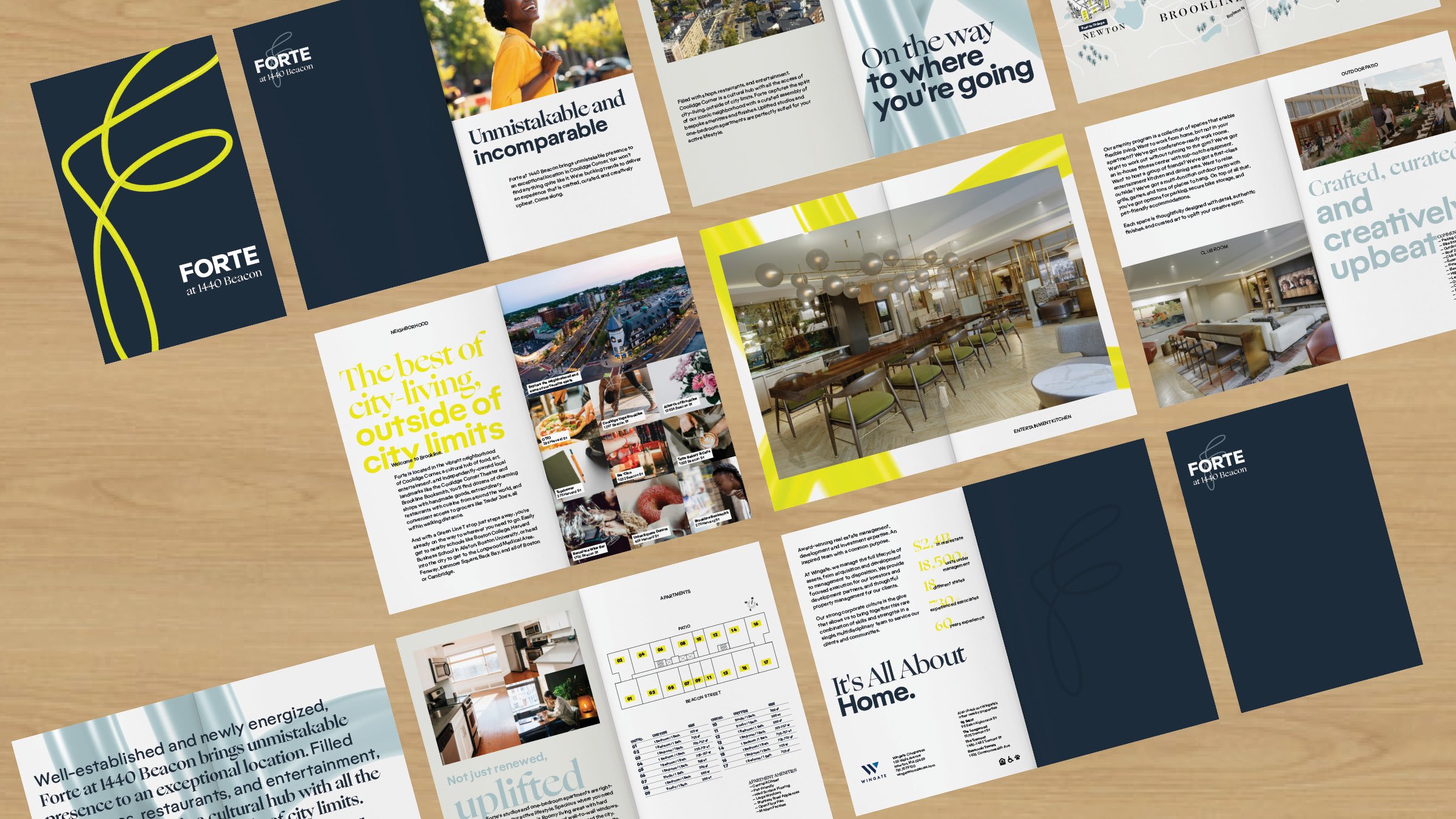
Forte, a repositioned community in Brookline, has a completely different set of traits, because it’s a completely different type of community for a completely different target audience. Not every apartment community is for the same, stereotypical emerging professional, growing family, and empty nester! The project team came up with some fascinating responses for our brand ambassadors. There was Jimmy Fallon, Millie Bobby Brown, Harry Styles, Lady Gaga, Lenny Kravitz, Robert Downey, Jr., Ben Affleck, and the cast from Grey’s Anatomy. This group of personalities, let us to our personality traits:
→ Unmistakable
→ Young at heart / Wise beyond our years
→ Genuine
→ Reliable
→ Creatively upbeat
How do those personality traits show up in the brand?
Unmistakable means that the brand has a sense of class and charm, without the stuffiness. Young at heart was a unique trait we arrived at because of the repositioning of the property. Despite a well-established presence in the neighborhood, we still wanted the brand to be lively to appeal to a younger demographic and signal a newly energized community. Genuine is the quality of just being plain nice, like you want to hold the elevator door open for your neighbor and not slam the ‘close door’ button to avoid them. (Can a brand personality influence whether a resident holds the elevator door open? I hope so!) Creatively upbeat means the brand conveys an optimistic and inspiring tone through expressive visual and verbal language.
Cambridge Community Housing
My latest project (and newest case study), Cambridge Community Housing is a scattered site portfolio in the Cambridge area with a brand presence for not just one community, but an asset collection of over 700 units in 65 buildings. Working with a core team, we arrived at celebrities like Jon Bon Jovi for his generational versatility and philanthropic community outreach, Selena Gomez for her influential presence across diverse populations, and one of the most unique responses… a drum circle! We imagined a celebratory event with residents participating in a drum circle, which led to a discussion about inclusivity and participatory events for the community. Answers like these are why I love this question! These responses led to our personality traits:
→ Empathetic
→ Dependable
→ Inclusive
→ Pragmatic
→ Dynamic
How do those personality traits show up in the brand?
Empathetic and dependable are related to how the management firm cares for its community, showing understanding, and providing reassurance even in unpredictable times. We represent inclusive through the design of the symbol, segmented elements coming together to form a singular icon. Pragmatic means its rational and designed from simple shapes, geometric principles to for a timeless symbol. And dynamic comes through with the bright and energetic blue and movement within the logo. When defining strong brand characteristics, it becomes easier to translate these into tangible expressions, ensuring consistency across all touchpoints, from marketing materials to customer interactions.
What you can next:
Just as I’ve worked with client teams on these projects to establish their ‘celebrity spokespeople’ and the personality traits that define the brands, you too can think of who your celebrity spokesperson or brand ambassador would be.
Who would you choose and why?
What qualities do they have that you associate with your brand?
Have fun with it!
Once you do, let me know who your celebrity spokesperson is. I'd be interested to hear about it!
That’s all for the June issue of Build Mode!
Thanks again for being here.
If you have any ideas to share, or questions to ask, reach out. I’m open to hearing your thoughts and making this most useful message in your inbox this week. If you think this might help a friend, feel free to forward it to them and encourage them to join us.
Wishing you a wonderful month of June and hope to talk soon!
Best.
Kenny Isidoro
See my latest on Instagram, LinkedIn, or feel free to book a call.
Personality is an unbroken series of successful gestures.
— F. Scott Fitzgerald
Subscribe to Build Mode™
a monthly update with brand insights and how they can apply to your practice and your projects. Issues drop on the first of each month. Feel free to unsubscribe if the updates aren't valuable for you. No hard feelings.
The sweetest sound in any language
Everything you need to know about what makes a great brand name
Build Mode™ Issue 05.2024Thanks for being a part of the fourth issue of Build Mode! We have an ambitious group of professionals working in real estate, architecture, engineering, construction, marketing, design, and development. Welcome all!
Today’s issue is all about naming, whether it’s a property brand for a place, or your professional services company, or your service offering. Whatever it is, naming requires a deliberate process to get to an effective result. The common misconception is that anyone can do it.
Jot a few words down.
Open a thesaurus.
Eureka moment.
Land the name!
But that’s rarely the case, especially in a modern age when hundreds of thousands of companies have registered literally MILLIONS of trademarked brand names.
Any name you come up with needs to be property vetted.
Without the proper vetting, an environmental consulting business might end up sharing the same name as an oil distribution company (whoops!).
Without further ado, let’s get into it.
What makes a good name?
A good name is more than just creative. It needs to strike a balance between being creative, strategic, and technical. (that’s according to Rob Meyerson, author of the book Brand Naming, and I agree).

Good brand names are creative, strategy, and technical
Strategic
Much like its counterpart of brand strategy, a brand name must be unique in the market, different from other industry players. It needs to be distinctive in how it helps position the brand. If you follow naming trends, you’re taking a big risk… more on that below.
Creative
Now from a creative standpoint, it needs to be memorable, sound good, and look good. Yeah, even before it becomes a logo, it needs to look good.
For a recent naming project I led, we were down to two names on the shortlist:
Topograph and Interridge, both were favored by the project team almost equally.
Both names had really great meaning connected to the value propositions of the community, adaptability to exist beyond the development, and distinctiveness in the market. They also sounded good. They were both quite memorable, and yet, as a team, we just couldn’t get over the fact that these two R’s in the middle of Interridge just looked weird. For that reason, we took it out of contention, which made it easier for us to select the name that fit all our criteria: Topograph. (did you catch the case study?)
Technical
And finally, it needs to be technical, meaning it needs to be legally available without trademark infringement, linguistically viable without major conflict in other languages, plus easy to spell and pronounce.
The combination of these three major criteria are what make up a good name.
Just creative and strategic, without technical, it will invite a cease and desist letter
Just strategic and technical, without creative, it’ll feel bland and forgettable
Just technical and creative, without strategic, it won’t be able to grow with you
Types of names
There are lots of different ways to categorize names – founders’ names, coined words, historical references, compound words, Latin origins, acronyms, portmanteaus, and more – but the way I see it, you can put all of these into three major groupings, ranging from descriptive to suggestive to abstract.
Descriptive
Descriptive names clearly convey information about the brand. For example, Joe’s Northeast Plumbing Service is a descriptive name.These are less creative but most informational. These names usually include founders’ names or initials, the location of the business, or a descriptor of the service or product offering. The more descriptive the name, the less adaptable it becomes to evolving partners, geographic market areas, or service offering.
Suggestive
Suggestive names can offer a subtle clue as to what distinguishes the brand. As a consumer brand example, you’ve got Away, a brand that sells luggage with a name suggestive of travel. Or, Grubhub, a digital platform to get some ‘grub’ (slang for food, but you knew that). Sometimes, what makes these names more descriptive is when they’re paired with a modifier that establishes some sense of information.
Abstract
And finally, abstract names convey an intangible quality without any practical description of what the brand is or what the brand does. Many popular brands choose this category for its adaptability and memorability. For example:
Starbucks has nothing to do with the first mate in the novel Moby Dick
Apple has nothing to do with the fruit
Everlane has nothing to do with infinite roads
Avalon (the property brand) has nothing to do with the mythical island it’s named after
These names dismiss being descriptive in favor of being creative and memorable (and trademark-able)
For those familiar with the real estate and architecture scene in the Boston area, here’s a sampling of how some names would shake out within each category.

Why choosing the right name matters
Because it needs to be adaptable
If you’re a professional services firm, looking at ownership transitions, or expanded service offerings, and you’ve got a name in the descriptive category, you’ve got to be really strategic. Does the firm name change with a new partner? Does it rebrand? Will it lead to loss of brand recall and brand equity? If so, all of a sudden your name has become a business problem. It’s a safer bet for the long-term growth of a firm to adopt a name that empowers everyone within it. It has to be strategic to adapt to the firm’s growth. And it has to be creative to stand out and be memorable. Firms need to think far into the future when considering a name, even if they’re just getting started.
Because it needs to be available
In the worst case scenario, the wrong name will cost you money, or worse, your reputation. Take this example…
Adding -ify or -ly had been a popular trend in naming. It seemed to be an easy way to turn any word into a coined name.
Bitly, the URL shortener
Optimizely, the digital marketing platform
Insightly, the CRM tool
Tattly, the temporary tattoo brand
Spotify, the digital music service
Shopify, the e-commerce platform
Propify, a property technology company... or rather, two property technology companies
Propify is a property management software built for single family rental homes. It was also, at one point, a technology company that built an API to allow for the integration of multiple property management systems.
Different companies. Similar products. Same name. That’s a problem!
Both entered the market around the same time too, around 2020. But with Propify filing a trademark for the name in 2022, the integration tool had to back out of the name they had been using for years and made the switch to Propexo. One can assume using ‘Prop-’ in the name retained some of their brand equity, but the change of the suffix still didn’t do much to differentiate the brand in the proptech space.
This is a lesson in ensuring your name is distinct by avoiding trends, doing your due diligence, and seeking uncommon language to stand out.
Because it needs to be creative
Names are a vessel for a brand. They carry meaning with them. Consider how some brands carry certain perceptions based on the industry they exist in.
Especially in residential communities, consider how descriptive names like these carry a certain perception.
Chestnut Village
Glen Meadow Farms
Oak Hill Apartments
Colonial Village
Without even knowing them (I actually just made these up), you probably have an idea in your head on what these places might look like.
Compare those to more suggestive and abstract names like the ones below, which carry emotive and visual opportunities for their brand identities:
Rivermark
Ink Block
Avenir
The Brynx
When naming a property brand, not only are you looking for a name that is creative and memorable, but you’ll also want to consider how the perception of your name fits within (or stands out from) the context.
What you can do next:
If your organization is going through transition and thinking about your name, your offerings, consider embarking on a strategy and naming process with me. It’s a comprehensive process and there won’t be any eureka moments when you’ll just know you’ve landed on ‘the one.’ We’ll work through naming criteria, a long list, a short list, and due diligence to ensure we get to a great name.
If you’re a developer or know a developer who thinks a building address is a ‘brand,’ steer your ship in the right direction! and get started with branding and naming. Hopefully from the insights shared above, you see the importance of naming in the context of real estate.
If you’re embarking on a naming process on your own or with another partner, keep an open mind. The name is just one part of the brand. It will be surrounded by context. It can’t, won’t, and shouldn’t say everything you need to convey about your brand within the name. It’s just one piece of an entire brand system.
Naming is a challenging yet exciting part of branding.
It’s an imaginative leap into the unknown, an incredible moment in a brand’s journey to envision what might become before it fully exists.
That’s all for the May issue of Build Mode!
Thanks again for being here.
If you have any ideas to share, or questions to ask, reach out. I’m open to hearing your thoughts and making this most useful message in your inbox this week. If you think this might help a friend, feel free to forward it to them and encourage them to join us.
Wishing you a wonderful month of May and hope to talk soon!
Best.
Kenny Isidoro
See my latest on Instagram, LinkedIn, or feel free to book a call.
Work zone
Some other things I’ve been up to this past monthDesigning:
I’ve just wrapped up a project with Cambridge Community Housing, the scattered site portfolio owned by HRI and managed by Wingate Companies. It’s a timeless brand identity that captures the energetic spirit of the community with the professional rigor of the team’s operations. Can’t wait to share the case study soon!
Collaborating:
As a multidisciplinary practitioner, I’ve been stacking skills on skills over the past several years, but there’s a limit to what I can do. That’s why I’m excited to be collaborating with interior architects, render studios, and signage manufacturers on some current projects and partnerships.
Losing:
I’m coaching my two oldest kids’ soccer teams this spring, 6th grade girls and 4th grade boys, and both teams have suffered losses the last couple of weeks. I love winning, but I hate losing even more, so I’m motivated to get to work each week with young athletes and strive for progress.
Remember that a person’s name is to that person, the sweetest and most important sound in any language.
Subscribe to Build Mode™
a monthly update with brand insights and how they can apply to your practice and your projects. Issues drop on the first of each month. Feel free to unsubscribe if the updates aren't valuable for you. No hard feelings.
Branding that resonates
Understanding your intended audience so you can bring them value
Build Mode™ Issue 04.2024Hello and welcome to this issue of Build Mode, a monthly update with brand insights to help you level up your business. We have an ambitious group of professionals working in real estate, architecture, engineering, construction, marketing, design, and development. You all inspire me to keep sharing, so thank you for being here.
Haven’t subscribed yet? Consider joining us and get the next issue delivered straight to your inbox on the first of the month.Your company can’t possibly appeal to anyone and everyone. It’d be a mistake to try. If your branding tries to appeal to everyone, it’ll end up so broad and generic that no one would bother to notice it.
By identifying a specific market and ideal client, you’ll be able to understand their unique needs and desires, appeal to them through your brand, and empower your business to grow.
In today’s update, I’ll share how you can reach and resonate with those that truly value what you do.
Who are your people?
An intended audience (sometimes called a target audience, but that feels sort of ‘combative’ to me) is a segment of the population that would benefit from what you offer and whose values align with your own. They are usually individuals or companies with common characteristics, like demographics, or industry, or interests, or a combination of these.
Put simply, it’s the people you’re trying to reach.
And it doesn’t need to be limited to just one segment. There may be a small handful of segments with slight differences.
For example, a real estate investment firm might have different types of investors and affiliates they want to appeal to for a newly established fund. All with the shared common industry of real estate investment, but with unique traits.
One segment might be data-driven. More discerning than the average investor, these individuals would meticulously evaluate investment options. They prioritize understanding a firm’s track record and expertise.
Another might be more instinctual. They know what they’re looking for and a firm would serve them well by listening to their needs and guiding them accordingly. Their decision-making relies on chemistry and relationships, making trust easier to earn through rapport-building.
And yet another might not be an investor at all, but the conduit to investors. While prioritizing their role as responsible fiduciaries for their clients' investments, they are also driven by their own incentives. Clear and memorable information would be essential for them to deliver trustworthy advice and instill confidence in their clients.

So while an investment firm has an intended broader audience of ‘real estate investors’, understanding the specific traits of different segments within it helps identify what they care about most and how to appeal to their needs. If you’re writing and speaking to them, you’ll want messaging that is tailored, relevant, and brings them the highest value.
Why this matters:
Setting intentions on who your audience is helps you focus your branding and marketing efforts. Remember, we said we can’t possibly appeal to anyone and everyone. You can’t expect to be able to broadcast a message to reach millions of people and get prospects knocking down your door.
Your branding and marketing is most effective when it reaches those that are most likely to be interested in what you offer. Identifying and focusing on ideal clients allows you to appeal to your intended audience, maximize your effectiveness, and build stronger and more fulfilling client relationships.
So how can you be most ‘appealing’ to your intended audience?
Appealing isn’t just about being attractive (of course a brand that looks good is important – but beauty is only skin deep).
It’s resonance too.
Resonance is the sense of deep connection to one another on something that feels true.
To be truly resonant with those you serve, your brand needs to appeal to their psychological needs, their subjective desires and aspirations. Clients often make purchasing decisions based not on the rational benefits of a product, but rather, on how a product satisfies their emotional needs and resonates with their identity and values.
There’s a psychological theory, Maslow's Hierarchy of Needs, that reminds us that human motivation is driven by a hierarchical arrangement of needs, ranging from the most basic to the highest aspirations.

Maslow’s Hierarchy of Needs
Let's break it down:
→ At the base of Maslow's pyramid, we have physiological – the need for food, water, shelter, and sleep. Products that fulfill our physiological needs are often commoditized. The brands that elevate their messaging to higher level needs become more appealing to prospects (think Casper for the mattress industry, or Liquid Death in the packaged water category).
→ Moving up the pyramid, we encounter safety – the need for security, stability, and protection from harm. How can our offering provide peace of mind and assurance to our audience? You see marketing messaging for security from brands like Ring, Volvo, and Norton Antivirus, which appeal primarily for our need for safety.
→ Next up, we have love and belonging – the need for social connection, relationships, and a sense of community. Humans are social creatures by nature. How can we foster a sense of belonging and camaraderie within our community of customers? For multifamily developers, think about what a common amenity space is really for and how to clearly message the benefits of connection and building a sense of community with our human need for love and belonging.
→ As we ascend the pyramid, we reach esteem – the need for recognition, respect, and self-esteem. How can we empower them to achieve their goals and aspirations, bolstering their self-confidence along the way? Many luxury brands play in this space, knowing that carrying their logo – whether it’s Louis Vuitton, Mercedes-Benz, or Rolex – is reflecting a self-image that commands recognition.
Finally, at the pinnacle of Maslow's pyramid, we have self-actualization – the need for personal growth, fulfillment, and realizing one's full potential. I’m not sure about you, but my social feed has been flooded with personal development coaches pitching their courses, with a key message that speaks to our innate desire to see the best version of ourselves actualized.
What you can do right now:
Now that you know about intended audience and how to speak to their emotional needs, let’s look at how you can effectively identify the people you’re trying to reach and deliver a brand that resonates.
Develop a profile for each person
For each of your intended audience segments, develop a profile for them. There might be only one, or there might be five, but usually no more than that. If you find yourself writing for more than five, there’s a likelihood that some of your segments might be similar enough that they can be consolidated. Like the real estate investment firm examples above, develop multiple profiles to represent different segments of your market, ensuring a comprehensive understanding of your audience.
The profiles I develop have four parts:
1. Write a description of who they are and what they value
What are their pain points, desires, fears, and aspirations? The insights here come from knowing your current clients, former clients, and conversations with prospective clients. What do they prioritize in life, and what principles guide their decision-making process?
2. Identify their functional needs
What do clients get when they work with you? Literally - what’s the deliverable? Functional needs pertain to the practical, tangible requirements that clients seek to fulfill through a product or service. They are the product, the features, the solutions.
3. Identify their emotional needs
How do clients feels when they work with you? What are their emotional needs and how they fit into the levels of Maslow’s Hierarchy of Needs (physiological, security, belonging, esteem, and achievement)?
4. Develop value proposition(s)
With the insights on their functional and emotional needs, and how your product can deliver on those needs, articulate how your product or service addresses their pain points, fulfills their desires, and aligns with their core values. Where their pain points and your offer overlap lies your unique value proposition. This unique value proposition, along with the benefits you offer, further separates you from other industry players.
And finally, put yourself in their shoes. With every word you write, every graphic you create, every brand touchpoint with them… make sure it appeals to them, but more importantly, make sure it resonates.
That’s a wrap for the April issue of Build Mode!
If you have any ideas to share, or questions to ask, reach out. I’m open to hearing your thoughts and making this most useful message in your inbox this week. If you think this might help a friend, feel free to forward it to them and encourage them to join us.
Wishing you a wonderful month of April. Talk soon!
Best.
Kenny Isidoro
Work zone
Some other things I’ve been up to this past monthLaunching:
The case study for Topograph is live! It's been fun to collaborate with Eastland Partners and Wingate Companies on this one. Through an in-depth brand strategy, we identified the qualities that could make this place special, and then we went all-in on bringing this breath of fresh air to Auburn, MA. Check it out → Topograph.
Mentoring:
Last week was the kickoff for AIGA Boston's mentorship program and I'm thrilled to be matched up with a young designer fresh out of school and exploring what's next for him. The program is a great way to stay connected to the organization and help guide professionals to the next version of their professional selves.
Archiving:
If you weren’t here for last month’s issue of Build Mode on brand positioning, you can find it at mudeo.ck.page (for now). I’m still working on finding the right place for past issues and whether they stay on a separate site, on my own website as blog posts, or just as emails.
Experimenting:
I’m considering putting together a subscription service model. On-demand branding and marketing services for business leaders in build mode. Interested? If your organization would like to take part in a pilot program (aka be a guinea pig), give me a ring!
If you want to find the secrets of the universe,
think in terms of energy, frequency, and vibration.
Subscribe to Build Mode™
a monthly update with brand insights and how they can apply to your practice and your projects. Issues drop on the first of each month. Feel free to unsubscribe if the updates aren't valuable for you. No hard feelings.
Forget competition - you win when you play your own game
How to define your brand position
Build Mode™ Issue 03.2024Welcome to this issue of Build Mode! I’m so glad you’ve joined us. We have an ambitious bunch here made up of professionals working in real estate, architecture, engineering, construction, marketing, design, and development. Welcome all!
Haven’t subscribed yet? Consider joining us below and get the next issue delivered straight to your inbox on the first of the month.Ever find yourself competing with other companies? Or worse, competing with other companies on price? Ugh. Multiple players in the mix. All with a similar offering, a similar message, a similar approach?
Especially in markets that are perceived as commodities, (yeah, sometimes that includes architecture and construction) focusing on what makes you different is the secret to unleashing your brand's potential and standing out among the crowd.
Brand positioning is the process of getting there.
What’s brand positioning?
Positioning is one of the core components of brand strategy (arguably the most important, from a business perspective, among the four components – purpose, people, position, personality).
Brand positioning is the act of intentionally choosing your place in the market, one where no one else occupies, or can occupy.
It’s not only your space in the market, but also the space you take up in the mind of your audience.
How do you get to a brand position? The simplest way is to answer the question: ‘what makes you different?’ but there’s more to it than just that.
Being different makes you stand out.
Standing out makes you more memorable.
Memorability makes you more likely to attract and appeal to your ideal audience, whether it’s your next prospect or talent in your organization.
Brand position often exists in the form of a statement that indicates what makes you different, as well as the set of attributes that define what you offer, what market you’re in, and how your value is different from what others can offer.
Brand position can also exist as literal position or placement on a map of your industry. To evaluate potential gaps in the market, brands are often plotted onto an industry landscape with two axes. You can define the values and attributes of your axes to your liking. For example, one axis might be a range of price points from ‘economy’ to ‘premium’ while the other might be a personality trait like ‘corporate and stiff’ to ‘casual and friendly.’ By mapping brands to coordinates based on secondary research and gut instinct, you can reveal insights in your market, and potential areas to position your brand.

Why does it matter?
If you don’t define who you are, others will do it for you. Meaning, without a brand position that you define yourself, you’ll be categorized next to every other firm just like yours, and continue to compete for market share.
To separate yourself from the market, you need to show up and present your position in a way that speaks to your audience's needs, and expresses it through your message, identity, and offering.
There’s a survey question that is often asked in market research and consumer reports… it goes something like “within the category of X, which brands do you know of?” For example, which coffee brands come to mind? Someone might respond with Starbucks, Dunkin’, Peet’s, Blue Bottle, Caffe Nero, La Colombe… and then trail off. You want to achieve unaided brand awareness, also known as brand recall. It’s when customers can remember your business and know what it’s about because you’ve shown up in the market and made that distinction clear. Simply being known is the first step. Being known for what you intend is next level. The aim is to reduce the perception gap between what you say you are and what your audience thinks you are.
Here’s what you can do next
To define your own brand position, you need to define how you’re different. Here are five steps to get you there.
Step 1: Identify other industry players
(side note: I’m not using the word ‘competitors’, and that’s on purpose. There’s a train of thought in business that to ‘win’ you need to increase market share by obliterating the competition. But an increase in market share doesn’t necessarily mean an increase in business if the market size remains status quo. An increase in market share is dependent on the size of the market. I’m not a fan of this ‘competitive’ approach to business.)
The way I see it, the market is full of players in the game of business. Many players will compete against each other, trying to one-up each other with the next feature, monitoring their every move, claiming to be ‘better,’ or the first, or the fastest, or the biggest.
There’s a different game to play.
The game to play is one where you define your own rules. Know what others are doing so you can separate yourself into an open segment of the market.
Other industry players are the ones that are already on your radar. You run into them frequently. They are the firms on the same shortlist. They’re the existing providers you’re trying to dethrone. They are the contractors you’re bidding against. They are the ones you admire and also, the ones you despise!
Step 2: Research those industry players
Unless we have access to their internal brand strategy, the only way to understand how other industry players are positioning themselves is through their messaging. By reading and extrapolating what they say, we can interpret what they intend.
Visit the website of each industry player and look for these things:
What is their primary message? You’ll likely find this at the top of the home page or about page. Their primary message might be an indicator of their positioning.
What are their top three features and benefits? You might find this within their approach, services, or features page. Identify what benefits they are offering and to who
What is their visual identity? You’ve read into their messaging, now look at how they visually express themselves and what kind of personality they portray.
Step 3: Identify your differentiating factors
Through your industry audit, you’ll have found the positioning, values, and visual identity that other industry players offer. Now let’s focus on your unique set of attributes.
A good way to start is to list out every possible attribute that defines your brand.
Every.
Single.
One.
You should have a list of at least 50 attributes (even if, at first, they are similar to other industry players.) Once you have a large list of attributes that define your brand, compare them to the benefits of other industry players you developed. Which of these are unique to you, and you only? Choose a handful. These are your unique value propositions - the factors and values that customers can only get from you. As you go through these attributes, pay close attention to ones that get you excited and stand out among the rest. This may be your 'big idea.' See next step.
Step 4: Write a position statement
If you look up what’s included in a positioning statement, you may find templated statements with fill-in-the-blanks for target audience, category, key customer benefits, and alternatives.
Bleh. There are multiple problems with position statement templates. One, they're usually a mouthful. Two, they're uninspiring. Three, to suggest a brand position can be completed with a fill-in-the-blank is just plain wrong. Positioning isn’t Mad Libs.
When writing your position statement, don’t follow a template. What’s most important in your position statement is that you identify one big idea that makes you different from all other brands. This idea could come from the unique attributes you found in the previous step. Whatever the idea is, whether it’s the type of people you serve, or your unique approach, or your unique qualifications, or something else. Lean into the one thing that makes you the only one in a category that can deliver on this promise.
Some examples of brand positions:
For my brand agency MUDEO, I’ve defined my position as “Branding for business leaders in build mode.” It clearly identifies what I do and the unique group I’m focused on supporting – those who are ambitious and operating in the built environment through design, construction, real estate, or management.
For a new residential community coming soon to Auburn, MA, the core position is “a breath of fresh air” – highlighting refreshingly new housing stock and appealing to those who want to get outside the city and into nature.
For a popular brand like Warby Parker, their mission is “to inspire and impact the world with vision, purpose, and style” which could also be interpreted as their positioning. The inclusion of ‘impact the world’ is a clear reference to their unique Buy a Pair, Give a Pair program where they donate pairs of glasses to people in need around the world.
Step 5: Keep positioning at the center of everything you do
Positioning isn’t just a part of a brand strategy, it’s the key driver for your business. Every marketing initiative, every business decision, every bit of communication should reinforce your position.
It’s how you stand out
It’s how you’re remembered
It’s what you stand for
It’s what people love about you
It’s what keeps them coming back again and again
TL;DR
Forget competition. Use brand positioning to define what makes you different, setting you apart and occupying space that no one else can. Be aware of what other industry players are up to, then define your own space. Be a category of one to eliminate competition and stand out in the minds of your ideal audience.
That’s a wrap for this issue of Build Mode! Thanks again for being here.
If you have any ideas to share, or questions to ask, reach out. I’m open to hearing your thoughts and making this most useful message in your inbox this week. If you think this might help a friend, feel free to forward it to them and encourage them to join us.
Wishing you a wonderful month of March and hope to talk soon!
Best.
Kenny Isidoro
Work zone
Some other things I’ve been up to this past monthLearning:
I’ve recently completed a couple more courses through Section on storytelling and data to earn certificates in strategic communication and leadership. My membership in the program recently expired and I’m considering new learning opportunities. Where and how do you learn.
Designing:
Over the past few months, I’ve been working with Eastland Partners, a real estate developer based in Worcester, and property management firm Wingate Companies, to develop the brand for Topograph, a new residential community in Auburn. Keep an eye out for a case study coming soon!
Experimenting:
I’m considering putting together a subscription service model. On-demand branding and marketing services for business leaders in build mode. Interested? If your organization would like to take part in a pilot program (aka be a guinea pig), give me a ring!
Knowing yourself is the beginning of all wisdom.
Subscribe to Build Mode™
a monthly update with brand insights and how they can apply to your practice and your projects. Issues drop on the first of each month. Feel free to unsubscribe if the updates aren't valuable for you. No hard feelings.
Setting the foundation for brand architecture
The four types of company structures and how to find yours
Build Mode™ Issue 02.2024There’s been some chatter in the architecture industry lately (or maybe it’s always been there and continually resurfacing) about how the terms ‘architect’ and ‘architecture’ have been co-opted, or rather hijacked, by lots of different industries, especially the tech industry. We now have data architects, information architects, enterprise architects, solutions architects, and many more.
I get it. And it makes sense. Architecture, beyond the practice of designing and constructing buildings, is a really useful term to describe the intentional planning and structuring of, well, anything. And that includes brand architecture, the topic for today.
Just as architecture is the combination and integration of forms and materials, establishing the foundation for occupants to inhabit, so too does brand architecture establish the setting for a brand through its intentional relationships.
What is brand architecture?
At its most basic level, brand architecture is the organizational structure and perceptual relationships between a parent brand and its sub-brands, products, and services.
Brands are complex things. They serve different markets. They have different products. They have different value segments. They have partnerships, affiliations, and endorsements. And there’s a lot of messiness and complexity within their business. Brand architecture is the process that organizes the chaos into a structure that makes it easy to understand. Whether the brand is a real estate developer, or an international design agency, or a car manufacturer, organizing the brand portfolio for clarity and leverage of the parent brand is paramount.
Let’s look at an example of how a customer navigates through brand architecture and understanding of structural relationships in a real world scenario.
Say you’re in the market for a new vehicle. You were initially researching differences between Kia, Honda, and Toyota and you decided on a Kia. That’s the top level of the structure: the brand.
Now you’re walking around the dealership, avoiding the sales associate because “you’re just looking” and you’re figuring out whether you prefer a crossover, an SUV, or an MPV (apparently that’s the new nickname for minivans now), because you know a sedan will be too small for you. Oh, there’s also a whole range of EVs too, but you decide on a standard SUV. These are examples of product types and the next level of your structure. It’s one way to create classification through brand groupings.
Now that you know you want an SUV, you’ve got size options with different models at each scale. On the larger end is the Telluride, and on the compact side is the Seltos, with Sportage and Sorento in the middle. Let’s go with the Telluride. All of these vehicle models are product brands, or sub-brands.
Think we’re done going down the rabbit hole of brand architecture hierarchy yet? Think again. Within the Telluride brand, there are even more options. Each of the trims are indicators of quality, from a basic model LX starting at $36,190 through all the options in between, S, EX, EX X-Line, SX, SX X-Line, SX X-Pro, SX Prestige, EX Prestige X-Line, and at the highest tier, the SX Prestige X-Pro starting at $53,385 (by the way, who named these?). The trim options create a vertical pricing structure that gives you the option to choose on level of quality.
Through the buying process illustrated above, you can see how a car manufacturer has structured their offering in a clear way (despite the trim names), so customers know exactly what options are offered.
The four basic models of brand architecture
There are four types of brand architecture models: branded house, sub-branded, endorsed, and house of brands.

Branded house
The first brand architectural model is a branded house. Brands in this model go to market with a single name, single brand mark, and generally, operate within a single category. They are incredibly focused. All of the products and services drive value to the parent brand.
UPS operates as a single brand name and brand mark with one primary service of delivering items worldwide. All of the products and services fit the same category, whether they are shipping goods by ground or air or freight, or helping customers ship their goods through physical retail locations.
In the design field, there are companies like Gensler, one name, one brand mark, yet working across dozens of markets through the service offering of architecture, design, and planning. Even upon acquisition of firms, targeted firms integrate swiftly within the branded house model to leverage Gensler’s international reputation. For example, when Gensler acquired Boston-based brand agency Korn Design in 2018, their strategy was to consolidate and integrate their team into Gensler’s Boston office and expand their capabilities as a lifestyle branding studio.
Sub-branded
Our next brand architecture model is sub-branded. The Kia example from above fits here. The Telluride is a sub-brand to Kia, just as the Wrangler is a sub-brand to Jeep, and the Mustang is a sub-brand to Ford. This is true for most car manufacturers. Sub-brands are brands that sit a level below the parent brand and retain association with the parent for enhanced benefit and leveraged equity.
In the building industry, many firms create sub-brands by categorizing their services. See Gilbane as an example. Since the late 1990s, Gilbane, Inc. has been the holding company for two sub-brands: Gilbane Building Company, their construction and facilities brand, and Gilbane Development Company, their real estate development, investment, and management brand. Since they offer an entirely different set of services, they adopted this sub-branded model. Through both entity’s association with Gilbane, both strengthen the name.
In real estate, Millcreek Residential has given names to their asset categories to create sub-brands. Within their portfolio is Amavi, single-family rental communities; Beckett, well-crafted apartment homes; Modera for a ‘new standard’ in apartment living, and Alister, apartment homes at great value. Their product brands, one level deeper, are modified with locations, so their local assets become Alister Quincy, Alister Oak Hill, Alister Baco Raton, which adds consistency and efficiency with brand management and setting customer expectations across the category.
A word of caution with sub-brands in real estate – if the property changes ownership or management, yet the building name remains the same, it’s possible that it becomes mistakenly associated with the original ownership and management firm, thus leaving a former owner susceptible to negative impacts on their brand equity.
Endorsed
The third example for a brand architecture model is endorsed. Endorsed brands are independent brands with a noticeable but minor affiliation with a parent brand or holding company. In practice, an endorsement might appear as a tagline added to the name and logo. An endorsement from a brand with greater brand equity gives the customer more assurance on the quality of the product.
3M has many products within its portfolio, including popular brands like Scotch tape, Post-It notes, and Command strips. Each of the brands are strong on their own but with the backing of 3M (and a logo on the packaging) they receive a brand equity boost because of their affiliation with a higher level, reputable parent brand.
When global firm PA Consulting acquired Boston-based innovation design studio Essential Design in 2018, they adopted for an endorsed approach with “part of PA Consulting” as a tagline in their name. The endorsement started a transitional phase. While Essential’s clients began to recognize the resources available through their association with PA Consulting, Essential Design brought new expertise in-house and expanded PA’s service offering and geographic reach across the globe. They have since fully integrated and become a branded house.
House of brands
The fourth type of brand architecture is a house of brands. House of brands are brands that exist across multiple categories and across multiple value propositions. They are independently branded with little to no connection to the parent brand. Sometimes, there’s an intentional disassociation from the parent brand.
Does Boston Beer Company make beer? Technically, yes, but it’s not a beer brand. They’re a holding company for many brands, or in other words, a house of brands. In their brand portfolio are drink brands across multiple categories: Samuel Adams, Truly Hard Seltzer, Twisted Tea, Angry Orchard, Dogfish Head, and new innovations like Teapot, the cannabis-infused tea. Each of their portfolio brands has strong brand equity and doesn’t leverage the parent brand.
Just as there are holding companies for consumer brands, there are also holding companies for design agencies. Look to kyu, a collective of creative organizations that form partnerships to move the needle on the economy and society. You may recognize some of the names in their portfolio like IDEO, Sid Lee, SYPartners, Godfrey Dadich, and Upstatement, the digital design studio founded in Boston. Within kyu’s brand portfolio, they each maintain their own identity while leveraging the resources of the collective and work together toward one mission.
So these are the four main models of brand architecture: branded house, sub-branded, endorsed, and house of brands. In reality, most firms use a hybrid model with two of these structures to better support the firm’s business objectives.
What’s most important to understand is how each of the brands in the portfolio all play a part in reinforcing the growth of the parent brand or holding company.
Here’s what you can do next
If you’re leading a company or managing its brand reputation (yes, even if you’re an employee, you’re part of that brand’s reputation), it’s essential to see the big picture of how an entire portfolio of brands work together. It’s also a good idea to take an audit of how your business is positioned today to identify any gaps or inefficiencies in how the portfolio is structured.
With the insights above, you now know how to break down the components of a brand architecture, from the top-level holding company and flagship brand, into groups of categories with sub-brands, and tiered quality levels. You also know the four different models of brand architecture and the benefits of each.
So, which model is right for your own brand portfolio? Every brand has a brand portfolio and a brand architecture, even if you don’t have any sub-brands. You still have a set of products, services, or affiliations that need to be intentionally positioned for clarity and leverage.
When considering the brand architecture of your company, ask yourself these questions. This is by no means an exhaustive list of questions you need answered, but it’s a start to get your foundation right.
Current structure
What are all the brands, sub-brands, products, and services that compose your brand portfolio?
How is the portfolio organized and categorized?
What brand architecture model are you currently utilizing?
Is this model clear to everyone – internal, customers, future prospects – in the same way?
Is this model best for the strength of the parent brand and all sub-brands?
Is this model intentional and purposeful?
Portfolio performance
Which areas of the portfolio are driving the strongest growth right now?
Which areas of the portfolio might drive the strongest growth in the future?
How connected and related are the portfolio brands, if at all?
Might there be any associations to create stronger leverage across all segments of the portfolio? (for branded house)
Might there be any disassociation to create separation from conflicting areas of business? (for house of brands)
Future structures
Is the brand architecture adaptable to change?
Are there any new partnerships, affiliations, or services in the pipeline?
What’s the process for adapting the brand architecture with new brand extensions?
How will the brand architecture be represented and updated?
The objectives of an effective brand architecture
Ultimately, the goals for crafting a brand architecture come down to this:
To increase brand value
The composition of the brand portfolio, sub-brands, products, services, and extensions should all be positioned to increase the value of the brand. While your own biases may lead you to focus on a particular sector, your ultimate goal is to drive increased value for the entire portfolio.
To create synergy
Like neuron connections and communications through synapses in our brains, the individual nodes of the brand portfolio should connect and collaborate with one another. Through reinforced association and collaborative efficiencies, each of them become elevated and work harder than on their own.
To clarify the offer
There should be no doubt of what you can offer. Both customers and internal stakeholders should easily understand the structure of the business, navigate it intuitively, and ease into the buying process without friction. Intuitive structure. Clear naming. Easy selling.
To enable future growth
Brand architecture is more about looking ahead than looking back. and creating a framework that allows growth opportunities to occur within the established framework, for new products, new strategic acquisitions, or new markets or categories.
With an effective brand architecture, you’ll set the foundation for a brand to inhabit and for the entire portfolio to propel forward and thrive.
Thanks for reading the inaugural issue of Build Mode!
If you have any feedback on this update, or ideas to share, or questions to ask, reach out. I’m open to hearing your thoughts and making this most useful message for you this week.
Wishing you a wonderful month of February and hope to talk soon!
Best.
Kenny Isidoro
Work zone
Some other things I’ve been up to this past monthReading:
Key Person of Influence by Daniel Priestley. I’ve taken a different approach to reading lately. Rather than read written word (which I still enjoy), I’ve been listening to audiobooks and taking notes in the process. Spotify has tons of books available on their premium plan. I find it helps me remember more and take action on the things I’ve learned.
Learning:
I just wrapped up a course from Section called Proving Business Value with Nicole Alexander, former global head of marketing at Meta. It focused on how to write a business case from end-to-end, while also diving into the most critical financial metrics used to demonstrate financial impact.
Adventuring:
Will I have to update my passport? Not sure yet, but I recently nominated myself to speak at The Design Conference in Brisbane, Australia with a keynote that encourages designers to experiment, learn, and master multiple skills through their career roles. By doing so, they’re stacking a unique combination of skill sets to create a unicorn version of themselves in the market. Fingers crossed!
Experimenting:
I’m considering putting together a subscription service model. On-demand branding and marketing services for business leaders in build mode. Interested? If your organization would like to take part in a pilot program (aka be a guinea pig), give me a ring!
If you build it, they will come.
Subscribe to Build Mode™
a monthly update with brand insights and how they can apply to your practice and your projects. Issues drop on the first of each month. Feel free to unsubscribe if the updates aren't valuable for you. No hard feelings.