The 100x brand multiplier
Build Mode™ Issue 12.2025
Hello and welcome to this issue of Build Mode, a monthly update with brand insights to help you level up your business. We have an ambitious group of professionals working in real estate, architecture, engineering, construction, marketing, design, and development. You all inspire me to keep sharing, so thank you for being here.
Haven’t subscribed yet? Consider joining us and get the next issue delivered straight to your inbox on the first of the month.
In real estate and in business, the term ‘value’ gets thrown around a lot. In this issue of Build Mode, I want to dive deep on value creation and its relevance through the lens of branding.

What is value creation in branding?
Value creation in business is the fundamental process of making products or services that are more valuable to customers than the cost of the inputs, resulting in profit.
In real estate, value creation is enhancing a property's economic worth through active and strategic improvements, like renovations, building upgrades, operational improvements, repositioning, and (the hugely underrated) branding and experiential design.
In comparison…
Value creation in branding is the strategic process of increasing the value of a brand through the development of its intangible assets.
And here’s what makes it a completely irrational and unfair business advantage:
It can increase a brand’s value tenfold to a hundredfold.
For example:
You can buy a generic T-shirt (or a pack of three with a cornucopia of fruit on the label), for about $10. Put a Nike logo on it and say it’s made for running, and it’ll sell for ten times more at $100. Put a Louis Vuitton logo on it, and it’ll sell for $1,000. The product, an upper body garment, is functionally the same. But the brand is an exponential value multiplier.
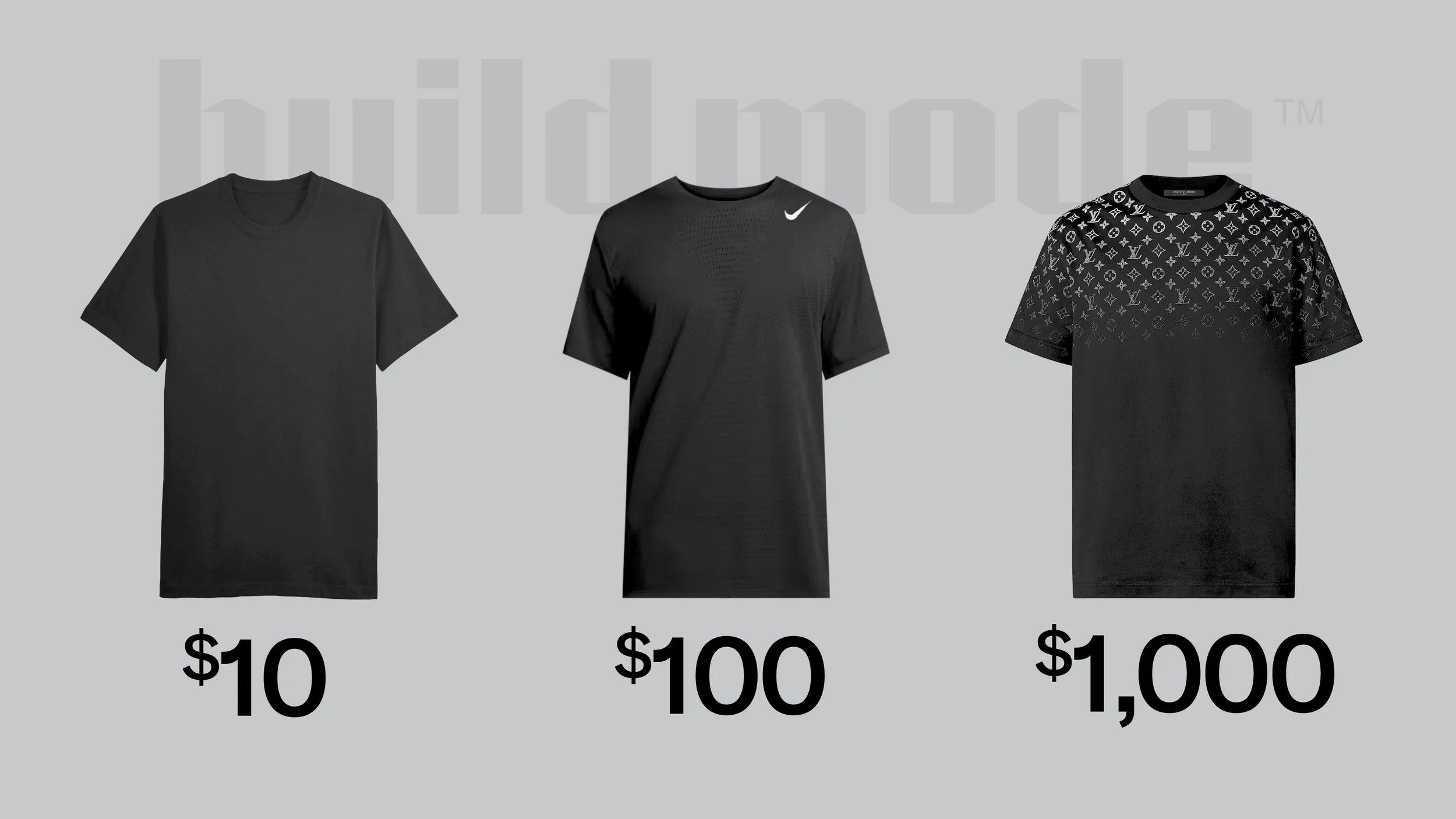
You can see this multiplier of 10x to 100x across every industry.
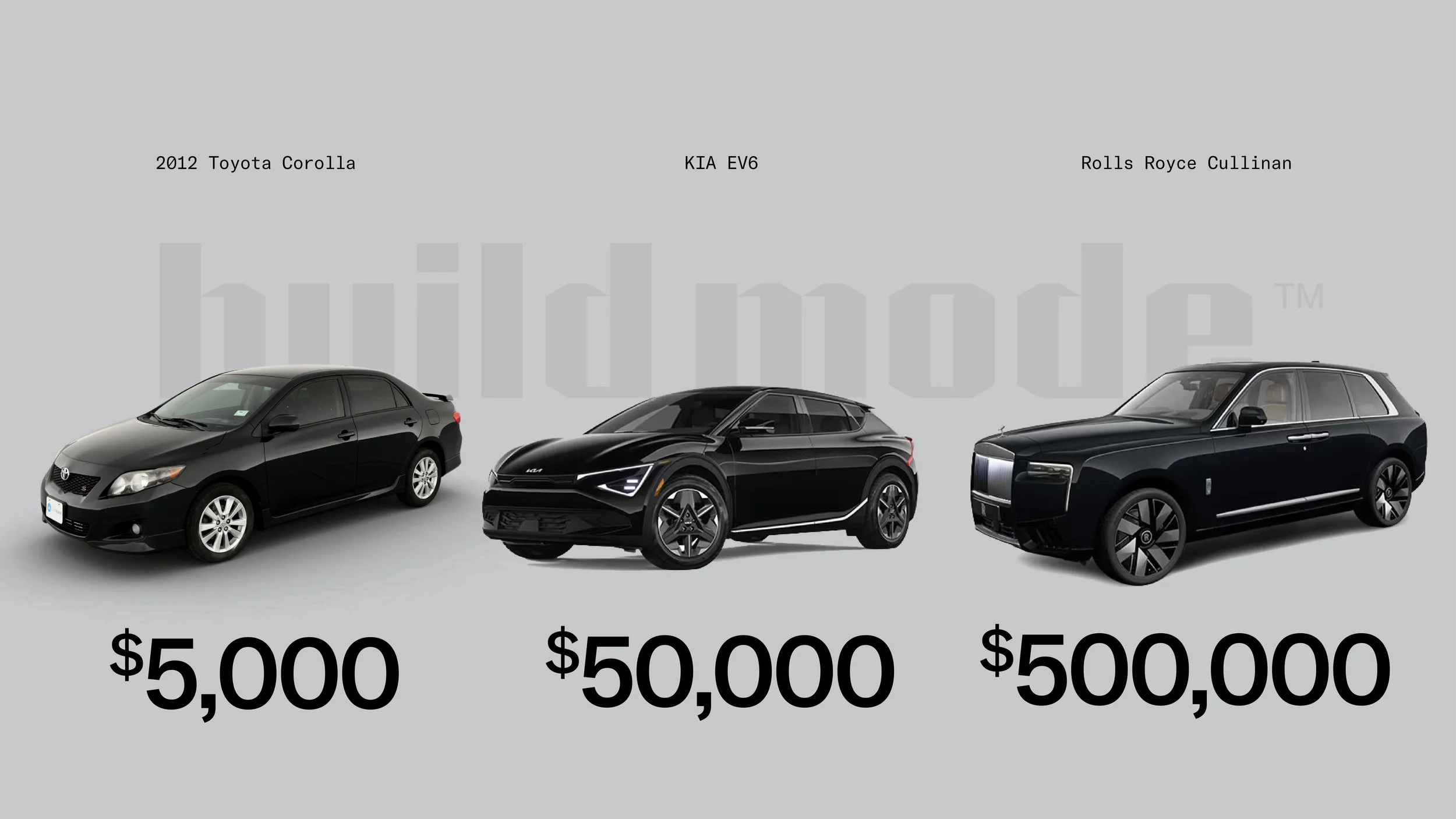
A used car: $5,000
A new, premium car: $50,000
A luxury, high-performance car: $500,000
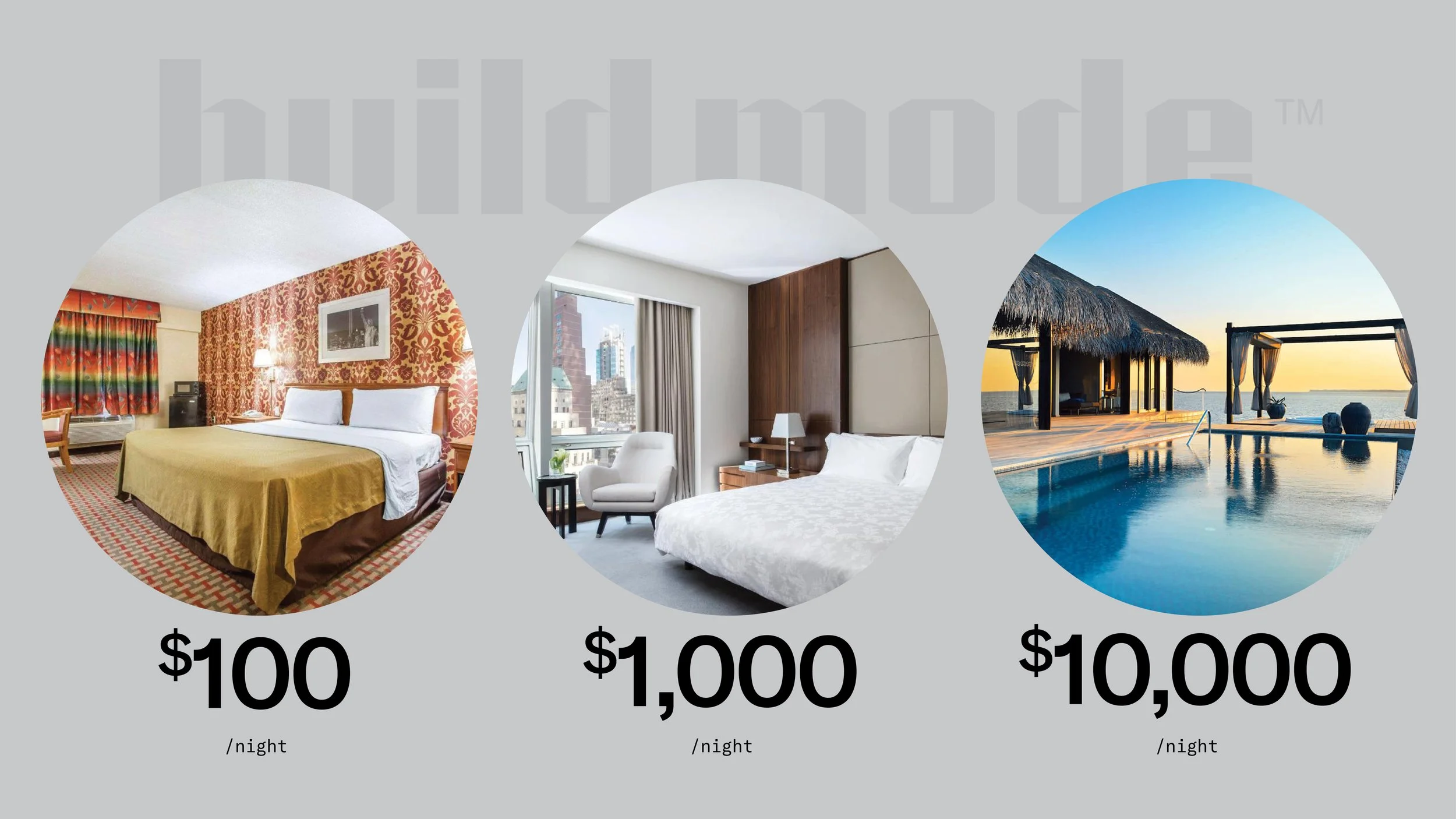
A one-night stay in a motel: $100
A one-night stay in a premium hotel with a view: $1,000
A one-night stay in a luxurious villa: $10,000
The same is true for professional services. Hire an amateur firm and they'll charge you $10,000. Hire a local, reputable firm and it’d be $100,000. Hire an internationally-recognized firm and you're in at $1,000,000.
Each of these are examples of value multipliers at work, the degree to which a brand can increase its economic value. The stronger the brand, the higher the value multiplier.
Brand is the reason people are willing to pay extra for what they want.
Why does value creation matter?
We humans are irrational creatures, and sometimes we make seemingly irrational decisions with our money. Even when a standard product would meet our needs, we often choose to spend more on products that carry strong brand value. We’re not paying 10x or 100x for materials or features. We’re buying into the meaning behind the brand, the status the products give us, the trust we’ve built with the people behind the company, and emotional experiences we have that the brand delivers.
Consumers make choices that may not make sense on paper because branding taps into our inner selves. Understanding why we choose certain brands, and how some can command 100x for the same cost of goods, reveals how value creation separates the brands that rise above the noise from those still competing on price. It shows why some brands earn preference, trust, and pricing power, and gives you, the business leader, clarity on the levers that drive demand and growth.
What you can do nextWhat to consider in value creation
I have a theory: a product or service with a strong brand should command a premium of between 10x and 100x the cost of a commoditized product.
So if you want to achieve a value multiplier of that level in your own offer, you must first define your industry’s commodity. How cheap can someone get the thing you offer? That's your floor. (By the way… the only ‘competition’ at that level is on price, since there’s zero value placed on branding, and if you’re here with me, you know that’s not the kind of business we’re in).
To go from commodity to a premium brand requires value creation activities focused in these four areas:
Awareness:
How you become known
Your brand can’t create value if people don’t know it exists! Brand awareness is being readily and easily recognized and recalled by others. It makes all other brand signals possible. And it requires presence in locations where the people you’re trying to reach are so you’re top-of-mind in their moment of need. Nike sponsors the world’s top athletes so they earn visibility and increased recognition on every major media outlet. They're also increasing presence in niche markets with collaborations and innovative product as competition from up-and-coming brands continue to challenge them.
Identity:
How you show up
Identity establishes your presence and signals quality before anyone interacts with you. After people become aware of your brand, your identity shapes their impression of you. Your identity should have cues that suggest the quality, so others perceive you as intended. Kia’s rebrand signaled its change from a budget car brand to a forward-looking, aspirational brand, following years of strategic product design.
Experience:
How you engage
Experience is where the promises you’ve made — in your awareness campaigns and in your brand’s expressions — are delivered. Through your product, service, communication, and every touchpoint in between. Rolls-Royce can charge 100x brand premiums because the experience of using the product reinforces the perceived status. Owners feel a sense of pride and social recognition when driving it because of its heritage and exclusivity. Plus, it comes with a whole host of services and access, intangibles that are central to value creation in luxury brands.
Influence:
How you lead
It’s one thing to be known, offer a quality product, and get clients coming back for more. It’s another thing to do it from a position that shapes the conversation in your industry. Influence is how your brand becomes a trusted authority, a category leader through visible expertise. In turn, others become confident in your leadership and your reputation creates trust, the ultimate accelerate for value creation. Even in the midst of declining luxury sales, Louis Vuitton is still ranked among the world’s most valuable brands because of its relentless focus on identity, emotional resonance, and cultural relevance.
By now I hope you can see that branding isn’t ‘decoration.’ These intangible elements and brand strengths — awareness, identity, experience, and influence — compound into real financial value. Branding is one of the most leveraged parts of your business, and understanding value creation is ultimately understanding how your brand turns perception into profit, and reputation into a long-term asset.
That’s all for this edition of Build Mode! If this resonated with you and you think it might help others, feel free to forward it to a colleague. And if you’d like to discuss how create value through branding, get in touch — I’d love to hear from you.
Best.
Kenny Isidoro

Price is what you pay. Value is what you get.
— Warren Buffet
Work zone
I work with business leaders in build mode, those who are ambitious and in a state of growth. If that's you and you're ready to build, there are two ways I can support you.
Brand audit
An analysis of your brand, plus other industry players, with recommendations for increasing its effectiveness in your business.
Discuss your audit.
Custom-built brand
A core service guiding business leaders through a linear process of defining or redefining your brand in four phases: discover, define, develop, and deliver.
Discuss your project.
Subscribe to Build Mode™
a monthly update with brand insights and how they can apply to your practice and your projects. Issues drop on the first of each month. Feel free to unsubscribe if the updates aren't valuable for you. No hard feelings.